I have come into possession of the recordings of a young man, Igor, who went to Kyiv with the intention of making a documentary called Kyiv Love. He wanted to find out how love is practised in besieged Kyiv: by older couples; by teenagers discovering love for the first time; by fathers and mothers with their children; by ravers seeking ecstasy; or by people devoted to a form of love that reaches beyond what is still bound to the individual—the collective, the universe, or a god, or whatever one might call it. He followed four couples and two individuals. He recorded their voices at the kitchen table, on the way to the school gates, and in bomb shelters.
We can all imagine what Kyiv sounds like: city traffic punctuated by sirens, air-raid alarms and explosions, but also the soft murmur of a warm coffee bar. At the heart of this besieged city, people continue to love.
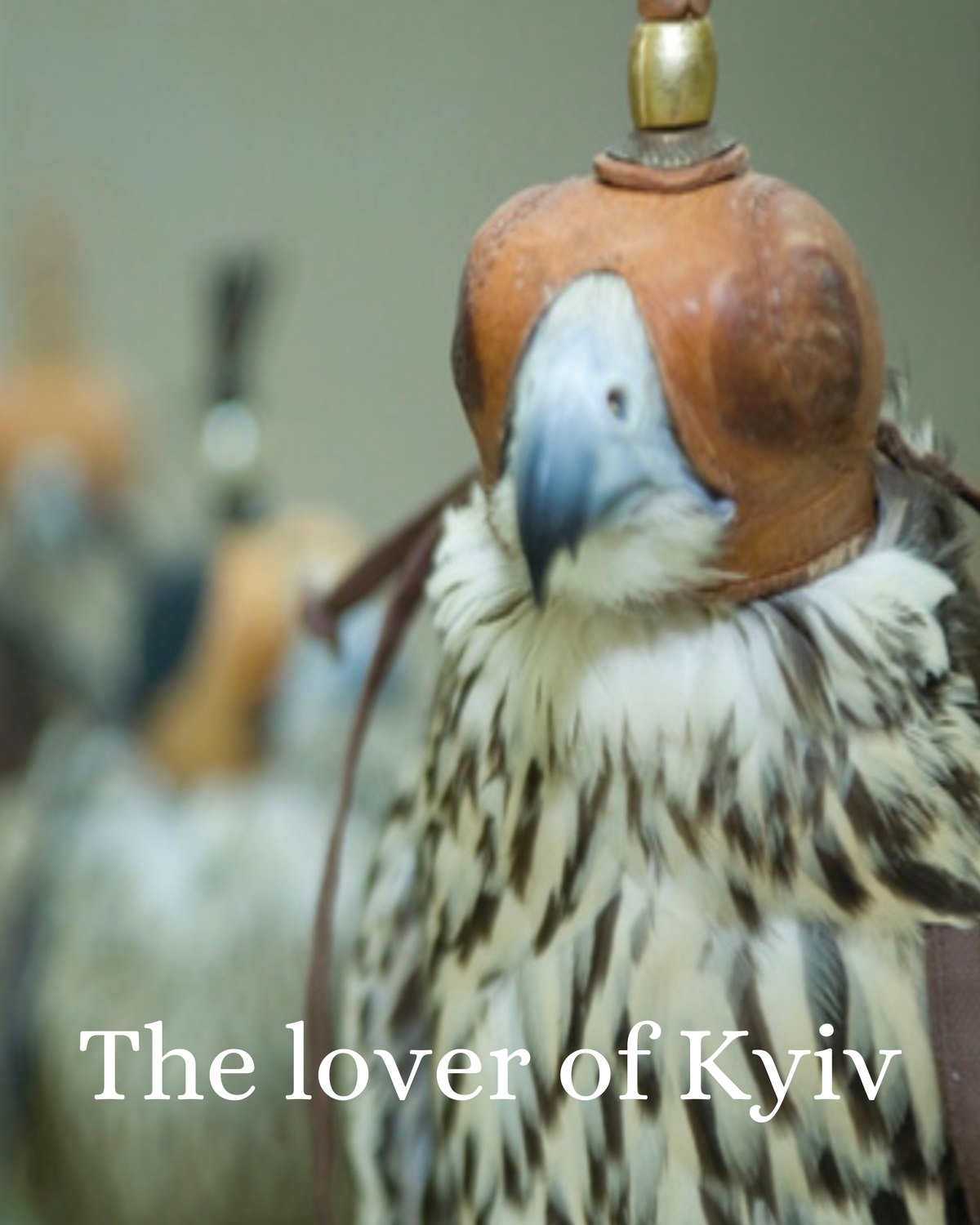
The documentary was never completed. But I have all his audio material, all his notes and diaries. For the sake of the safety of his surviving relatives, I cannot reveal his identity. It is possible that he is still alive. If I knew, I would not say so either, but honestly: I do not know. This much I can say: he is Russian, with Flemish roots, descended from a family of Flemish falconers who, from father to son, served Peter the Great and the Romanovs. A glorious past that, over the course of three successive generations, has fallen into poverty. All we know about Igor is that for a while he earned his living as a taxi driver in St Petersburg.
How his archive came into my possession is something I cannot disclose either, for reasons of my own safety. For those who do not trust this account: there is a notarised deed granting me permission to use everything. Thanks to his diaries and notes, I can reconstruct the way Igor searched for his path. The force driving him remains hidden behind the steel of his enigmatic fate. But I can trace the trail of his thoughts, fears and expectations as they propelled him through Kyiv’s dangerous maze.
Two almost obsessive thoughts turned out to be driving him forward. The first is an emblematic statement by Alain Badiou that recurs throughout his notes: “What is at stake in love is a reinvention of life.” This idea had completely overwhelmed him. He wanted to explore it down to the folds of the skin and the tiniest of gestures. First of all, he wanted to know: is it true? And if so, how and where does this reinvention of life manifest itself concretely? If there is anywhere in the world where this idea should be put to the test, surely it is here, in Kyiv?
The second thought comes from Hannah Arendt: “Amor mundi, love of the world, is the condition for political responsibility.” This, too, knocked him sideways. Nowhere else did he see so much “love of the world”; and so it was this thought that irrevocably transformed him into an acrobat of love. These inhabitants of Kyiv, who take on so much political responsibility—how immense must their amor mundi be? He wanted to know where this immense love for the world came from. From their hurried signings of the cross, their church hymns, their transgressive techno raves in bunkers, from the lament rising through overcrowded hospital corridors like the song of a whale? What sustains this amor mundi?
In The Lover of Kyiv, we encounter the inhabitants of Kyiv who love, who bear witness to how love changes in an occupied city, and how love changes both them and the city. And we are taken along by Igor, the Russian-Flemish son of falconers, an acrobat of love who, at the risk of his own life, goes to extraordinary lengths to record these testimonies of love with such precision that, like a child’s drawing caught in a fire, he disappears entirely into them.

← Back to Work